Orbwell.

Kingsville, Ontario · a one-engineer practice · est. on a workbench

The demo is my house.

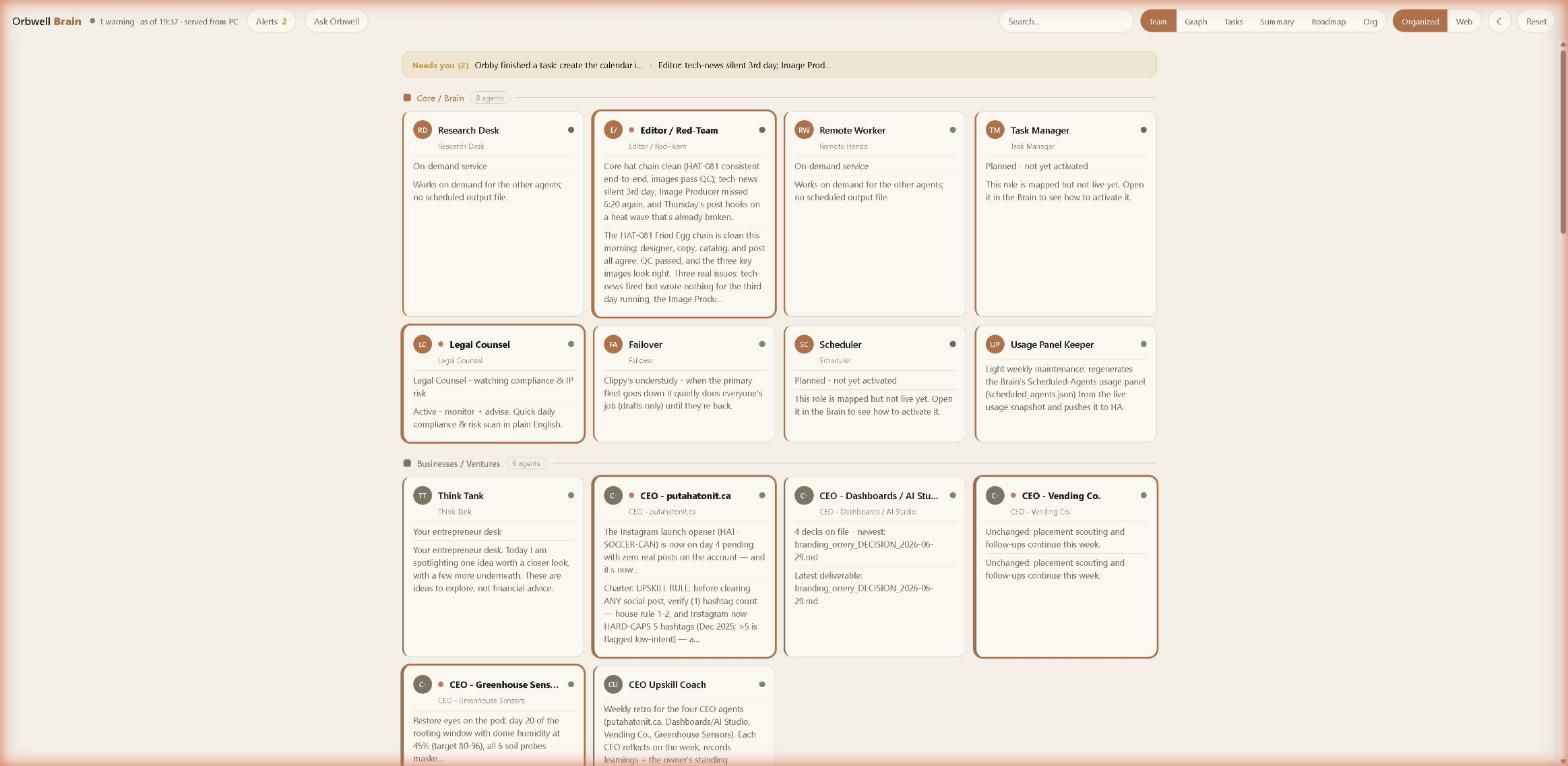
Orbwell builds AI agent fleets, home and greenhouse automation, and small solar hardware — then runs all of it, every day, on one real property. 38 scheduled agents. A three-product sensor line. Dashboards on five screens. Nothing below is a mockup, and every claim has a file timestamp behind it.

38
AI agents on daily schedule
3
hardware products in the line
1 day
CAD to live dashboard (TURF)
0
external requests on this page
01

Case files

all in service · imagery from the working CAD or the bench
CASE 01

The Home Assistant estate

Status in productionStack Home Assistant · Python · ClaudeProof 4 silent failures caught in one audit

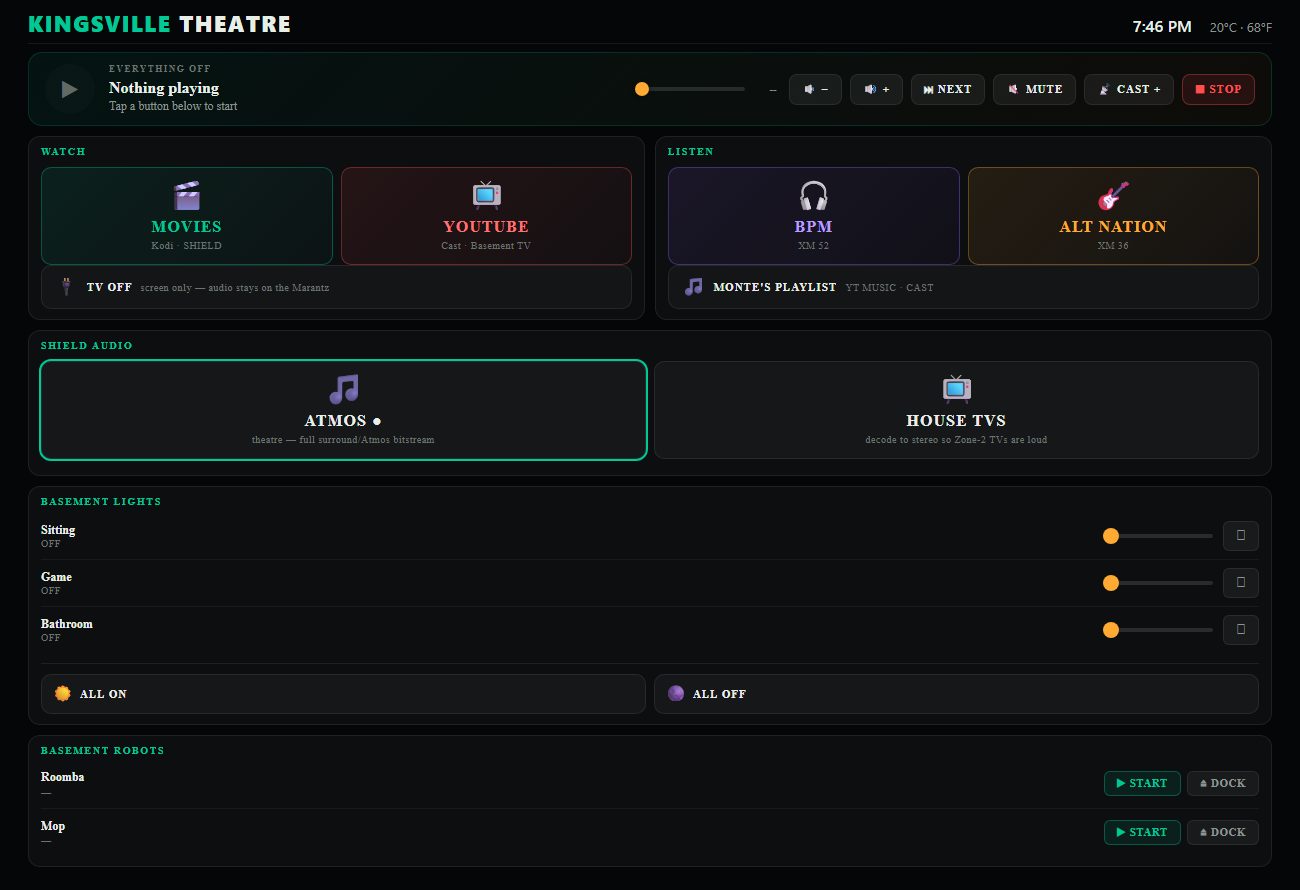
One property — house, greenhouse, lawn, theatre, print farm — run by a fleet of 38 scheduled AI agents on top of Home Assistant. Morning standups, inbox triage, greenhouse and lawn watchdogs, CEO-style desk reports for each small venture, a marketplace scout, and a night audit that re-reads the day's work.

The agents aren't the interesting part. The instrumentation is. A run recorder logs what each agent actually wrote. A watchdog compares file timestamps against the scheduler, because “the task fired” and “the work happened” are different claims. The night audit uses a second, independent model to cross-review — one model never grades its own homework.

That design earns its keep. A single audit pass caught four agents that had been firing on schedule and writing nothing — one of them quiet for two weeks. No log line would have told you that. A file timestamp did.

If an agent can fail silently, it isn't finished. That rule is most of the product.

  • By the numbers
  • Agents on schedule 38
  • Standup + CEO reports daily
  • Watchdog truth source file writes, not logs
  • Night audit independent model cross-review
  • Silent failures caught 4 in one pass
  • Screens driven office TV · theatre · tablets · kiosk
  • Anything public human-approved, per item
CASE 02

GrowV1 — a greenhouse sensor line

Status hardware in the fieldStack OpenSCAD · PETG · ESP32 · solarProof ~2.2 Wh/day node budget

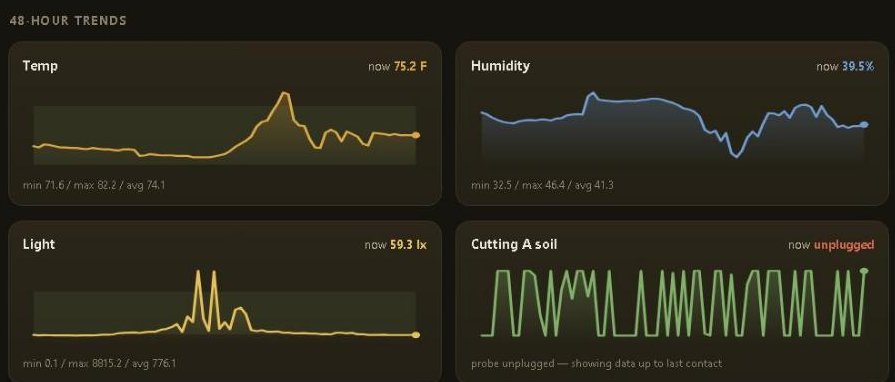
A three-product line designed, printed, and flashed in-house for a backyard greenhouse: the Pod (climate + camera node — ESP32-CAM, temperature, humidity, light — that clamps over a propagation tray), the Solar Power Box that feeds it, and TURF, a micro soil sensor (case 03).

The unglamorous work is power. Nodes sleep on a one-hour duty cycle and burn about 2.2 Wh a day — roughly twelve days of autonomy on a small pack, solar-positive in summer. The design target is December in Ontario, not a demo in July.

Every enclosure is parametric OpenSCAD. Meshes are verified before slicing, because a printer will happily spend six hours manufacturing a mistake.

  • Products Pod / Power Box / TURF
  • Node power budget ~2.2 Wh/day, 1-h duty cycle
  • Autonomy, no sun ~12 days on a small pack
  • Pipeline CAD → verified STL → firmware → HA
GrowV1 Pod on the bench, wired build with sensors and camera carrier before the lid goes on
Pod on the bench — wired, pre-lid. A real unit, not a composite.
GrowV1 Pod Rev J.1 assembled, base plus fan-ready lid, labeled CAD render
Pod Rev J.1 assembled — render straight from the working CAD.
TURF build number one: three printed parts plus bin electronics, annotated render
TURF build #1 — three prints + bin parts. Nothing to buy.
CASE 03

TURF — rev B to rev G in a day

Status Rev F built · Rev G drawnStack parametric CAD · mesh QC · ESP32Proof six revisions, one bench, one day

TURF is a micro soil-moisture sensor that installs like an irrigation peg — a Ø64 mm cap carrying a 50×50 solar cell on a Ø25 shaft, sitting 10 mm proud so the mower passes straight over it. It goes into the ground with a printed strike puck instead of a shovel.

It went from rev B to rev G in a day: parametric CAD, mesh-verified STL, firmware, and live readings in Home Assistant the same evening. Not heroics — a short pipeline. When design, verification, printing, and flashing share one bench, an iteration costs an hour, so you spend geometry instead of meetings.

The revisions were earned, not cosmetic: rev A trapped its own battery (component fit is now checked against the shell before anything prints); the head-house got an o-ring seat and a proper wire path; rev G swaps radio for a wired RS-485 Modbus variant with a parametric probe socket — drawn, verified, and deliberately unprinted until the real probe is measured.

An iteration that costs an hour changes what you're willing to fix.

TURF peg family, annotated render from the working CAD
The peg family — annotated render from the working CAD.
TURF mini peg cutaway showing cell, radio and probe path, annotated
Mini peg, cutaway — cell, radio, probe path.
TURF head-house macro cross-section: o-ring seat, sensing chamber, wire path
Head-house macro — o-ring seat, chamber, wire path.
CASE 04

Put A Hat On It — an AI product pipeline with a storefront attached

Status live · putahatonit.caStack Blender · static site · vision QCProof renders derive from the print files

putahatonit.ca sells 3D-printed hats for robot mowers and vacuums. It also happens to be the testbed for a full AI product pipeline: design → render → copy → staged social, with a human approval gate on everything that ships or publishes.

The honesty rules are mechanical, not aspirational. Product renders are built in Blender from the actual print CAD, in the actual filament colours pulled from inventory. AI lifestyle images are allowed — labeled as impressions — and must pass a QC gate: deterministic checks, then a vision model, then a person. The gate has already bounced an AI image that forgot to include the product.

The catalog rebuilds automatically from approved SKUs only; the site is static and framework-free on Cloudflare Pages, like this one.

putahatonit.ca →

  • Pipeline rules
  • Renders from real CAD, true filament colour
  • AI imagery allowed, labeled, QC-gated
  • QC gate rules → vision model → human
  • Catalog rebuild automated, approved SKUs only
  • Publishing per-post human approval
  • Hosting Cloudflare Pages, static
Also on the bench: Datsun 260Z Pi telemetry (planned) Marketplace scout (live) Maple propagation program (stratifying) Greenhouse winter build — climate battery + thermal reservoir (scoped)
02

Services

everything above, done for your systems
S-01

AI agent fleets

Scheduled agents that do real work on your systems — triage, reporting, watchdogs, audits — built on the tools you already run. Every fleet ships instrumented: a run recorder, a fired-versus-wrote watchdog, and an independent review pass, so you can prove what ran and what it produced.

Measured by output on disk, not by demo videos.

S-02

Home & greenhouse automation

Home Assistant done properly: sensors, cameras, irrigation, heat, dashboards on the screens you actually look at. Power budgets sized for December, and alerting that says “this hardware is dark” instead of pretending it isn't.

S-03

Rapid hardware prototyping

Parametric CAD to verified STL to firmware to a live dashboard — in a day when the problem allows it. TURF (case 03) is the case study; the pitch is the same file, earlier.

How engagements run: small and fixed-scope. An audit of what you have, a first working build inside a week, instrumentation so you can see it working, then handoff with the source. Nothing recurring until something is running.

03

Contact

replies come from the engineer, because there is only the engineer

One email. No forms, no booking links, no chatbot. Tell me what runs badly — or what you wish ran at all — and I'll tell you whether agents or hardware can fix it, and what I'd build first.

tyler.vickerman@gmail.com